

Start Selling with LaunchMyStore Today
Start your online business today and get everything you need to build, manage, and grow your online store.


Customer Segmentation for Ecommerce: RFM + Practical Segments
 Isabella Reyes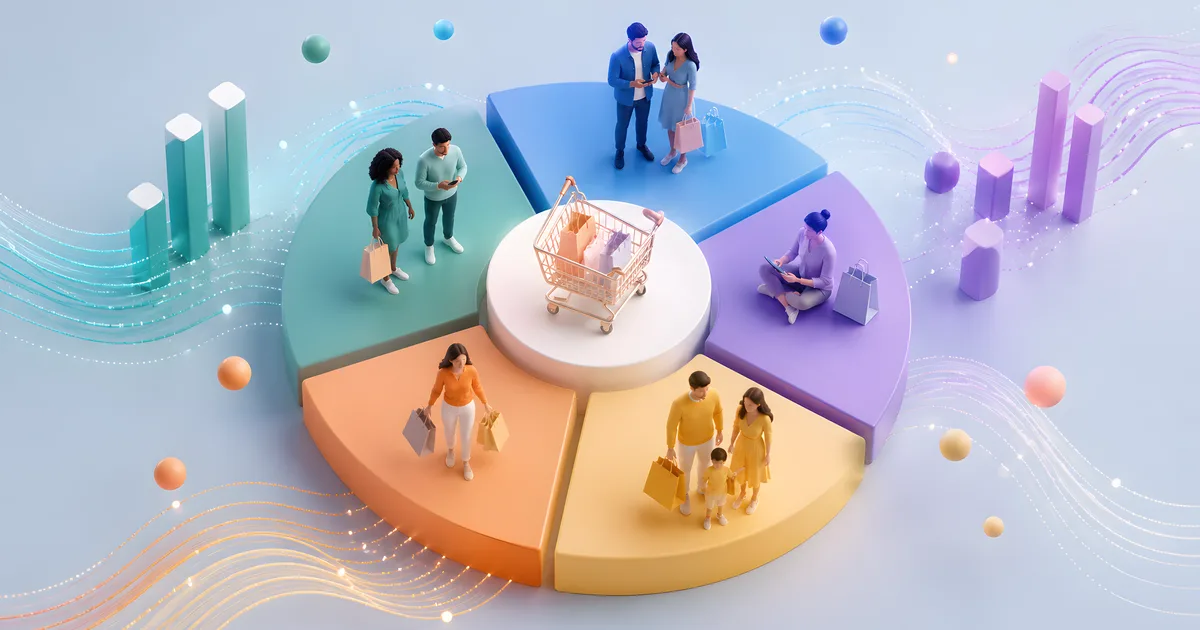
Start your online business today.
For free.
Start for freeSegmented email campaigns generate 760% more revenue than unsegmented blasts, according to Campaign Monitor (2025). By dividing customers into meaningful groups based on purchase behavior, demographics, lifecycle stage, and engagement level, ecommerce stores can deliver personalized marketing that dramatically increases open rates, click-through rates, and conversion rates. This guide covers RFM analysis, behavioral segmentation, lifecycle stages, tools, and automation workflows for LaunchMyStore merchants.
- Segmented campaigns achieve 14.31% higher open rates and 100.95% higher click rates than unsegmented ones (Mailchimp, 2025).
- RFM analysis scores customers 1 to 5 on recency, frequency, and monetary value, creating up to 125 segments.
- Champions are often just 5 to 10% of customers yet drive 30 to 40% of total revenue.
- Behavioral segments convert 3.4 times higher than demographic-only segments because they reflect current intent (Segment, 2025).
- Automated segmented campaigns generate 320% more revenue than manually sent segmented emails (Salesforce, 2025).
What Is Customer Segmentation in Ecommerce?
Customer segmentation in ecommerce is grouping your customers by shared traits — purchase recency, frequency, spend, behavior, or demographics — so each group gets messaging and offers that fit. The gold-standard method is RFM analysis (Recency, Frequency, Monetary value), which surfaces the six segments every store has: champions, loyal customers, promising newcomers, at-risk buyers, hibernating customers, and lost ones. Segmented campaigns consistently outperform blasts, which is why segmentation is the first step of any serious ecommerce email strategy.
Why Customer Segmentation Is the Foundation of Ecommerce Growth
Every customer who visits your store is different — different needs, different budgets, different buying frequencies, and different levels of brand loyalty. Yet the majority of ecommerce stores still send the same marketing message to their entire list. According to Campaign Monitor (2025), segmented email campaigns produce 760% more revenue than one-size-fits-all blasts. Mailchimp (2025) data shows segmented campaigns achieve 14.31% higher open rates and 100.95% higher click rates than unsegmented ones. The evidence is unambiguous: treating all customers the same leaves enormous revenue on the table.
Customer segmentation is the practice of dividing your customer base into distinct groups that share common characteristics. These groups receive tailored marketing messages, product recommendations, and offers that match their specific needs and behaviors. For LaunchMyStore merchants, segmentation transforms generic marketing into personalized conversations that drive higher conversion rates, increased average order values, and stronger customer loyalty.
The Business Impact of Segmentation
According to McKinsey (2025), brands that excel at personalization generate 40% more revenue from those activities than average players. Epsilon Research (2025) found that 80% of consumers are more likely to make a purchase when brands offer personalized experiences. The impact extends beyond revenue: segmented stores see 26% higher customer retention rates, per Bain & Company (2025), because customers feel understood and valued rather than treated as anonymous data points.
Segmentation vs. Personalization: Understanding the Difference
Segmentation groups customers with shared traits. Personalization tailors individual experiences within those groups. Segmentation is the foundation that makes personalization scalable. You segment first (group all VIP customers together), then personalize within the segment (recommend specific products based on each VIP’s purchase history). Without segmentation, true personalization is impossible at scale — you would need to manually craft messages for every individual customer.
RFM Analysis: The Gold Standard of Ecommerce Segmentation
RFM analysis segments customers based on three dimensions: Recency (how recently they purchased), Frequency (how often they purchase), and Monetary Value (how much they spend). Developed for direct mail marketing in the 1930s, RFM remains the most effective segmentation framework for ecommerce because it is built on actual purchase behavior rather than assumptions about demographics or preferences.
How RFM Scoring Works
Assign each customer a score of 1–5 on each dimension (5 being the best). A customer who purchased yesterday, buys monthly, and has a high average order value would score 5-5-5. A customer who last purchased a year ago, bought once, and spent minimally would score 1-1-1. This creates up to 125 unique segments, which you then group into actionable categories.
Key RFM Segments for Ecommerce
- Champions (5-5-5 to 4-4-4): Your best customers. They buy frequently, recently, and spend the most. Represent 5–10% of customers but often drive 30–40% of revenue. Strategy: loyalty rewards, VIP access, referral programs.
- Loyal Customers (3-4-4 to 4-5-3): Regular buyers with strong engagement. Strategy: cross-sell complementary products, invite to loyalty program tiers.
- Potential Loyalists (4-2-2 to 5-3-3): Recent buyers with moderate frequency. Strategy: nurture with targeted content, offer incentives for second and third purchases.
- At-Risk (2-3-3 to 2-4-4): Previously valuable customers whose recency has declined. Strategy: win-back campaigns, personalized re-engagement offers.
- Hibernating (1-1-2 to 2-2-2): Former customers who have not purchased in a long time. Strategy: aggressive win-back offers, sunset if unresponsive after 90 days.
- New Customers (5-1-1 to 5-1-3): Recent first-time buyers. Strategy: welcome sequences, onboarding content, second-purchase incentives.
Pro Tip: Start your RFM analysis by exporting your customer purchase data from LaunchMyStore (date of last purchase, number of orders, total spend). Use a spreadsheet to assign 1–5 scores for each dimension using quintiles (divide customers into five equal groups for each metric). This simple approach works remarkably well — you do not need expensive analytics software to get started.
Behavioral Segmentation: What Customers Do Tells You What They Want
Behavioral segmentation groups customers based on their actions on your site and with your marketing channels. Unlike demographic segmentation (which describes who customers are), behavioral segmentation reveals what customers want based on what they actually do. According to Segment (2025), behavioral segments drive 3.4 times higher conversion rates than demographic-only segments because they reflect current intent rather than static characteristics.
Browse Behavior Segments
Customers who repeatedly view a specific product category signal strong interest. Create segments for: category browsers (viewed 3+ products in a category without purchasing), product page visitors (viewed a specific product 2+ times), comparison shoppers (viewed similar products across multiple visits), and search-driven visitors (arrived via specific search queries). Each segment receives tailored messaging: category browsers get category-specific promotions, repeat product viewers get urgency-based messages (“Still thinking about it? Only 3 left in stock”), and search visitors get content that matches their search intent.
Purchase Behavior Segments
Segment by what customers buy, not just how often: single-category buyers (only purchase from one product category), cross-category buyers (purchase across multiple categories), discount buyers (only purchase during sales), full-price buyers (rarely use discount codes), and high-AOV buyers (consistently spend above your store average). According to Klaviyo (2025), stores that segment by purchase behavior see a 52% increase in repeat purchase rate from targeted campaigns.
Email Engagement Segments
Segment subscribers by their email behavior: highly engaged (open and click regularly), moderately engaged (open but rarely click), disengaged (no opens in 90+ days), and never engaged (never opened an email). Send your best offers and most frequent emails to highly engaged subscribers. Reduce frequency for moderate segments. Run re-engagement campaigns for disengaged subscribers and sunset those who remain unresponsive after 90 days. This protects your sender reputation and improves deliverability for the subscribers who matter most.
Revenue Impact: Segmented vs. Unsegmented Email Campaigns
Source: Campaign Monitor & Mailchimp, 2025
Demographic and Psychographic Segmentation
While behavioral segmentation is the most powerful for ecommerce, demographic and psychographic data add valuable context. Combining behavioral data (what customers do) with demographic data (who they are) and psychographic data (what they value) creates the richest customer profiles.
Demographic Segments
Common demographic segments for ecommerce include: age cohorts (Gen Z, Millennials, Gen X, Boomers), gender, geographic location (city, state, country), income level (inferred from purchase patterns), and household composition (single, couples, families). According to Salesforce (2025), adding demographic data to behavioral segments improves campaign performance by an additional 18%, because messaging can be tailored to both what customers want and how they prefer to receive communication.
Psychographic Segments
Psychographic segmentation groups customers by values, interests, attitudes, and lifestyle. For ecommerce, common psychographic segments include: value-conscious shoppers (motivated by deals and savings), quality-seekers (willing to pay more for premium products), eco-conscious buyers (prioritize sustainability), convenience-driven shoppers (prefer fast shipping and easy returns), and trend-followers (early adopters of new products). These segments are identified through purchase patterns, survey responses, and content engagement data.
Lifecycle Stage Segmentation
Every customer is at a different stage in their relationship with your brand. Lifecycle segmentation recognizes this and delivers stage-appropriate communication. According to Autopilot (2025), lifecycle-based email sequences generate 4.5 times more revenue per email than broadcast campaigns because they deliver the right message at the right time.
The Six Ecommerce Lifecycle Stages
- Prospect: Subscribed to your email list but has not purchased. Strategy: welcome sequence, first-purchase incentive, educational content about your products and brand.
- First-Time Buyer: Made their first purchase. Strategy: order follow-up, product care/usage tips, social proof reinforcement, second-purchase incentive.
- Repeat Customer: Made 2–3 purchases. Strategy: cross-sell recommendations, loyalty program introduction, exclusive previews of new products.
- Loyal Customer: Made 4+ purchases over 12+ months. Strategy: VIP treatment, early access, birthday/anniversary offers, referral program invitations.
- At-Risk: Previously active customer with declining engagement. Strategy: win-back email sequence, personalized re-engagement offer, feedback request.
- Lapsed: No purchase or engagement in 6+ months. Strategy: aggressive win-back offer, sunset warning, final unsubscribe prompt after 90 days of non-response.
Segmentation Tools for LaunchMyStore Merchants
Implementing segmentation requires tools that can collect, organize, and act on customer data. Here are the top tools for ecommerce segmentation, ranging from beginner-friendly to enterprise-grade.
| Tool | Starting Price | Segmentation Capabilities | Data Needed | Best For |
|---|---|---|---|---|
| Klaviyo | Free (up to 250 contacts) | RFM, behavioral, predictive analytics, 350+ integrations | Email, purchase, browse behavior | Ecommerce email & SMS segmentation |
| Segment (Twilio) | Free (1,000 visitors/mo) | Real-time behavioral tracking, identity resolution, 400+ integrations | All customer touchpoints | Customer Data Platform (CDP) for unified profiles |
| Google Analytics 4 | Free | Audience building, predictive audiences, custom segments | Website behavior, conversions | Traffic and conversion segmentation |
| Omnisend | Free (250 contacts) | Purchase behavior, engagement scoring, lifecycle automation | Email, purchase, browse behavior | SMB ecommerce email marketing |
| HubSpot | Free (basic CRM) | Contact scoring, lifecycle stages, custom properties | All CRM data | Stores needing CRM + marketing in one platform |
| Drip | $39/mo | Tags, custom fields, behavioral triggers, lead scoring | Email, purchase, site behavior | Advanced ecommerce automation |
Personalized Campaigns by Segment
Once you have defined your segments, the next step is creating targeted campaigns for each group. Here are proven campaign templates for the most impactful ecommerce segments.
Campaigns for New Customers
New customers need onboarding, not immediate upselling. Send a 5-email welcome sequence: (1) Thank you + order confirmation, (2) Brand story + values, (3) Product care/usage tips, (4) Social proof and reviews, (5) Second-purchase incentive (10–15% off, sent 14 days after first delivery). According to Klaviyo (2025), this type of structured onboarding sequence increases second-purchase rate by 33% compared to stores that send only a transactional order confirmation.
Campaigns for VIP/Champion Customers
Your Champions deserve exclusive treatment. Create a VIP experience: early access to new collections (24–48 hours before general launch), exclusive products or colorways only available to VIPs, surprise-and-delight gifts on purchase anniversaries, personal thank-you notes from the founder, and invitations to private sales events. According to Bond Brand Loyalty (2025), VIP program members spend 3.1 times more than non-members, and the emotional connection from exclusive treatment drives a 67% higher lifetime value.
Campaigns for At-Risk Customers
Win-back campaigns should escalate in urgency. Week 1: “We miss you” with personalized product recommendations based on past purchases. Week 3: Exclusive comeback offer (15–20% off). Week 6: Final incentive with strongest offer + urgency (“Your exclusive 25% off expires in 48 hours”). Week 10: Sunset warning (“We’re about to remove you from our list — want to stay?”). According to Omnisend (2025), this escalating win-back sequence recovers 12–18% of at-risk customers.
Campaigns for Discount-Only Buyers
Some customers only purchase during sales. Rather than fighting this behavior, leverage it: send them advance notice of upcoming promotions, clearance alerts, and loyalty points that reward purchase frequency. Gradually introduce full-price products through “recommended for you” sections in their emails. According to Retention Science (2025), 23% of discount-only buyers can be converted to full-price purchasers through gradual exposure and value-based messaging over 6 months.
Pro Tip: Create a “Segment Performance Dashboard” that tracks revenue per email, conversion rate, average order value, and unsubscribe rate for each segment. Review monthly to identify which segments are growing, which are declining, and where your highest ROI opportunities lie. If your Champion segment is shrinking while At-Risk is growing, you have a retention problem that needs immediate attention.
Automation Workflows for Segmented Marketing
Manual segmentation works, but automation scales it. According to Salesforce (2025), automated segmented campaigns generate 320% more revenue than manually sent segmented emails. Here are the essential automation workflows every ecommerce store should build.
Post-Purchase Flow (Triggered by Order Completion)
Automatically trigger a sequence based on the purchased product category: Day 0 — order confirmation with estimated delivery, Day 3 — product usage tips specific to the purchased item, Day 7 — review request with incentive (loyalty points or small discount), Day 14 — cross-sell recommendation based on purchase, Day 30 — replenishment reminder (for consumable products) or new arrival in same category. Each email dynamically adapts content based on the specific product purchased.
Browse Abandonment Flow (Triggered by Viewing Without Purchasing)
When a visitor views a product page but does not add to cart: send a “Still interested?” email 2 hours after browsing with the product image, reviews, and a gentle nudge. If no action, send a second email 24 hours later with social proof (“This product has been viewed 1,200 times this week”). For high-value products, add a third email at 72 hours with a personalized incentive. According to Barilliance (2025), browse abandonment flows recover 5–8% of abandoned browsers into purchasers.
RFM Score Change Flow (Triggered by Segment Migration)
Set up automations that trigger when a customer moves between RFM segments. When a Loyal customer drops to At-Risk (recency score decreases), automatically trigger the win-back sequence. When a New Customer moves to Repeat Customer (frequency increases), trigger a loyalty program invitation. These dynamic triggers ensure no customer falls through the cracks and every segment migration prompts an appropriate response.
Segments are only as good as the messages they receive — map each segment to a dedicated flow in your email marketing system so VIPs, at-risk buyers, and newcomers each hear something different.
Frequently Asked Questions
How many customer segments should I start with?
Start with 5–7 core segments: New Customers, Repeat Customers, VIP/Champions, At-Risk, Lapsed, Discount Buyers, and High-AOV Buyers. Once you have automated campaigns running for each of these segments and are seeing results, expand to more granular segments. Over-segmenting too early creates operational complexity without proportional revenue gains. Most stores see 80% of segmentation value from their first 5–7 segments.
What data do I need to start segmenting customers?
At minimum, you need: email address, date of first and last purchase, total number of orders, and total spend. This data is available in every LaunchMyStore dashboard and is sufficient for RFM analysis. For behavioral segmentation, you also need website browsing data (available through Google Analytics or your email platform’s tracking script) and email engagement data (opens, clicks — available in your email platform). You do not need demographic data to start.
How do I segment customers who have never purchased?
For email subscribers who have not yet purchased, segment by: source of signup (how they joined your list), email engagement level (opening and clicking behavior), and browse behavior (what pages and products they view on your site). A subscriber who joined via a product-page pop-up, opens every email, and regularly browses products is a high-intent prospect who deserves a strong first-purchase incentive. A subscriber who joined for a giveaway and never opens emails may need a re-engagement campaign or sunset.
How often should I update my customer segments?
Ideally, segments update in real time based on behavioral triggers. Tools like Klaviyo and Segment automatically move customers between segments as their behavior changes. If you are managing segments manually, update at least monthly. Quarterly updates miss too many segment migrations — a customer who bought two weeks ago should not sit in an “at-risk” segment for two more months because the segments have not been refreshed.
Can I segment with a small customer base (under 1,000 customers)?
Yes, but keep segments broader. With fewer than 1,000 customers, splitting into 10+ micro-segments creates groups too small to draw meaningful conclusions from. Stick to 3–5 broad segments (New, Active, VIP, At-Risk, Lapsed) and focus on creating distinct campaigns for each. As your customer base grows past 5,000, you can confidently add more granular segments. Even with 500 customers, a basic RFM segmentation will reveal that your top 10% drives disproportionate revenue — and that insight alone is actionable.
What is the difference between RFM segmentation and predictive segmentation?
RFM segmentation is backward-looking — it analyzes historical purchase data to categorize customers. Predictive segmentation uses machine learning to forecast future behavior: predicted next purchase date, predicted lifetime value, and churn probability. Tools like Klaviyo and Shopify now offer predictive metrics built in. Predictive segmentation is more powerful but requires at least 500+ customers with 12+ months of purchase history to generate reliable predictions. Start with RFM, graduate to predictive as your data matures.
Conclusion: Segmentation Turns Data Into Revenue
Customer segmentation is the single most impactful marketing practice an ecommerce store can implement. It transforms generic, spray-and-pray marketing into personalized, relevant communication that resonates with each customer’s unique needs and behaviors. The 760% revenue lift from segmented campaigns is not theoretical — it is achievable for any LaunchMyStore merchant willing to invest the time in understanding their customer data. Start with a basic RFM analysis using your existing purchase data. Identify your Champions, nurture your New Customers, re-engage your At-Risk segment, and sunset your truly Lapsed subscribers. Build one automated workflow for each segment, measure performance for 30 days, and iterate. The compounding effect of segmented marketing means that each month of optimization builds on the last, creating an increasingly powerful revenue engine that grows alongside your customer base.
Written by
Isabella Reyes
Data-Driven Marketing Specialist at LaunchMyStore. Helping online businesses scale with data-driven strategies and the latest ecommerce best practices.
 Keep Reading