

Start Selling with LaunchMyStore Today
Start your online business today and get everything you need to build, manage, and grow your online store.


Podcast Marketing for Ecommerce: How Audio Content Grows Your Brand
 Andrea Lawson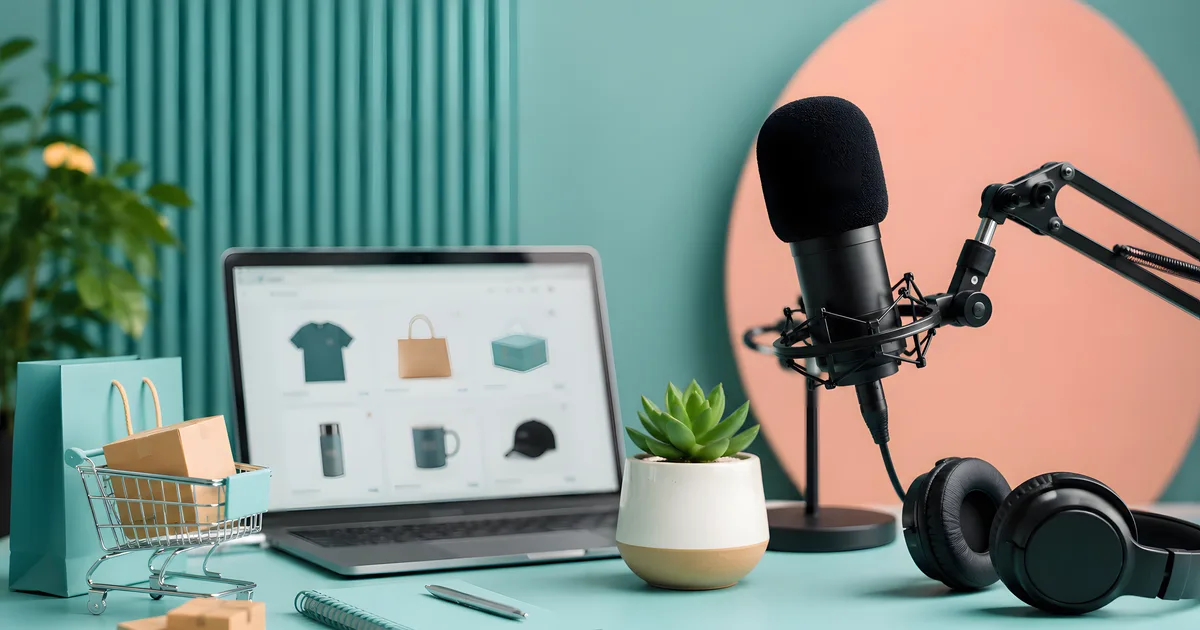
Start your online business today.
For free.
Start for freePodcast listeners are 54% more likely to purchase from advertised brands, and podcast advertising revenue is projected to exceed $4 billion in 2025. Ecommerce brands can leverage podcasting in two ways: launching their own branded podcast to build authority and community, or advertising on existing podcasts to reach engaged audiences. This guide covers both strategies, including episode formats, equipment, podcast SEO, guest booking, ROI measurement, and how to build a podcast-to-purchase funnel that drives revenue.
- Roughly 120 million Americans listen to podcasts monthly, and 81% have taken action after hearing a podcast ad.
- Host-read ads generate 71% higher brand recall than pre-produced ads because listeners trust the host's endorsement.
- A minimum viable podcast setup costs just $200–500 for a USB mic, headphones, and recording software.
- Even 200–500 highly targeted listeners can drive meaningful sales; quality of audience beats raw download numbers.
- Track ROI with unique promo codes, vanity URLs, and a "How did you hear about us?" checkout survey.
Why Podcast Marketing Is a Growth Engine for Ecommerce Brands
The podcast industry has matured from a niche medium into a mainstream marketing channel. According to Edison Research (2024), 42% of Americans aged 12 and older — approximately 120 million people — listen to podcasts monthly. Weekly listeners average 8 episodes per week, demonstrating deep engagement that few other media channels can match. Unlike social media scrolling or banner ad exposure, podcast listening is an intentional, focused activity. Listeners choose to spend 30–60 minutes with a show, creating an intimacy and trust level that translates directly into purchasing behavior.
The data on purchase influence is compelling. A 2024 study by Sounds Profitable found that 54% of podcast listeners are more likely to consider purchasing from brands they hear advertised on podcasts. The same study revealed that 81% of listeners have taken action after hearing a podcast ad, including visiting a website (62%), searching for a product (49%), or making a purchase (38%). These engagement rates dwarf those of display advertising, social media ads, and even influencer partnerships.
For ecommerce brands, podcasting offers a unique advantage: the ability to tell your brand story in depth. A 60-second Instagram ad cannot explain your sourcing philosophy, your founder’s journey, or why your product solves a specific problem better than alternatives. A 30-minute podcast episode can. This narrative depth builds the kind of brand affinity that drives not just first purchases, but lifetime customer value.
The Economics of Podcast Marketing
Podcast advertising costs range from $15–25 CPM (cost per thousand listeners) for programmatic ads to $25–50 CPM for host-read ads, according to AdvertiseCast (2024). For an ecommerce brand with a $50 average order value and a 3% conversion rate from podcast traffic, the math is favorable: at $25 CPM, you pay $25 to reach 1,000 listeners. If 3% visit your store and 3% of those convert, you generate 0.9 sales — roughly $45 in revenue from a $25 ad spend. Factor in customer lifetime value, and the ROI improves further.
U.S. Podcast Advertising Revenue (Billions USD)
Source: IAB/PwC U.S. Podcast Advertising Revenue Study, 2024 (*2025 projected)
Strategy 1: Launching a Branded Ecommerce Podcast
A branded podcast positions your ecommerce company as an authority in your niche, builds community around your brand, and creates a recurring touchpoint with your audience. Glossier’s “The Glossy Podcast,” Shopify’s “Shopify Masters,” and Beardbrand’s “Beardbrand Alliance” demonstrate how ecommerce brands use podcasts to drive awareness, loyalty, and sales without sounding like a 30-minute advertisement.
Choosing Your Podcast Format
The format you choose determines production complexity, audience expectations, and content sustainability. Here are the formats most effective for ecommerce brands:
- Interview format: Invite industry experts, customers, suppliers, or complementary brand founders as guests. This is the easiest format to sustain because guests bring their own stories and audiences. Ideal for brands that serve a specific community (fitness, cooking, sustainable living).
- Solo educational: The founder or a team member shares expertise on topics relevant to your audience. Works well for complex product categories (skincare ingredients, home improvement, nutrition). Requires strong subject matter knowledge and confident delivery.
- Storytelling/narrative: Tell the stories behind your products, your customers, or your industry. Higher production effort but exceptional engagement. Patagonia’s podcast uses this format to tell environmental stories that align with their brand values.
- Roundtable discussion: Two or three co-hosts discuss trending topics in your niche. Creates dynamic, conversational energy but requires consistent scheduling among multiple participants.
- Customer spotlight: Feature customers who use your products in interesting ways. Provides social proof while creating content your featured customers will share with their own networks.
Essential Equipment and Software
You do not need a professional studio to start a high-quality podcast. The minimum viable podcast setup costs $200–500:
- Microphone: The Audio-Technica ATR2100x-USB ($99) or Samson Q2U ($69) provide broadcast-quality audio via USB connection. Avoid using your laptop’s built-in microphone — audio quality is the single biggest factor in listener retention.
- Headphones: Any closed-back headphones ($30–50) to monitor your audio while recording and prevent echo.
- Recording software: Audacity (free) or GarageBand (free on Mac) for solo recording. Riverside.fm or Squadcast ($15–25/month) for remote interviews with separate audio tracks.
- Editing: Descript ($24/month) provides AI-powered editing that allows you to edit audio by editing a transcript. This dramatically reduces post-production time for non-audio professionals.
- Hosting: A podcast host distributes your show to Apple Podcasts, Spotify, and other platforms. Options include Buzzsprout, Transistor, and Podbean.
Pro Tip: Record your first three episodes before launching. This gives you a content buffer, allows you to refine your format and flow, and provides enough content for listeners to binge when they discover your show. Apple Podcasts’ algorithm favors new shows with multiple episodes and early listener engagement.
Strategy 2: Advertising on Existing Podcasts
If launching your own podcast feels too resource-intensive, advertising on established podcasts in your niche delivers immediate reach without content creation overhead. Podcast advertising comes in several forms, each with different characteristics:
Ad Formats for Ecommerce
- Host-read ads: The podcast host reads your ad copy in their own words, often weaving in personal experience with your product. Host-read ads generate 71% higher brand recall than pre-produced ads, according to Nielsen (2024), because listeners trust the host’s endorsement.
- Pre-roll ads: 15–30 second spots played before the episode content begins. Lower cost but also lower engagement, as many listeners skip the first 30 seconds.
- Mid-roll ads: 60-second spots placed in the middle of the episode, typically during a natural content break. Highest engagement because listeners are already committed to the episode and less likely to skip.
- Programmatic ads: Dynamically inserted into podcast episodes based on listener demographics and behavior. Lower CPM but no host endorsement. Best for retargeting and broad awareness campaigns.
- Sponsorship: Full episode or series sponsorship (“This episode is brought to you by...”). Highest cost but provides deep brand integration and association with the show’s content.
Finding the Right Podcasts for Your Brand
The most effective podcast advertising targets shows whose audiences closely match your customer persona. A high-end kitchenware brand should advertise on cooking podcasts, food culture shows, and home entertaining podcasts — not on the biggest podcast by download numbers. Niche alignment matters more than audience size.
- Podcast directories: Use Apple Podcasts, Spotify, and Listen Notes to search for podcasts in your category. Filter by relevance, popularity, and recency.
- Marketplace platforms: Podcorn, AdvertiseCast, and Gumball connect advertisers with podcast hosts. These platforms provide audience demographics, pricing, and booking tools.
- Direct outreach: For niche podcasts not listed on marketplaces, email the host directly. Many smaller podcasters welcome sponsorship inquiries and offer negotiable rates.
Podcast SEO: Getting Found in Search
Podcast SEO ensures your show appears when potential listeners search for topics in your niche. Unlike traditional SEO, podcast SEO spans multiple platforms: Apple Podcasts, Spotify, Google, and YouTube (which now supports podcast RSS feeds). Optimizing for discoverability is essential for growing your audience beyond your existing customer base.
Optimization Strategies
- Episode titles: Include your primary keyword naturally in each episode title. “How to Choose the Right Running Shoes for Marathon Training” is searchable; “Episode 47: The Big Race Chat” is not.
- Show notes and descriptions: Write detailed show notes (200–500 words) for each episode, incorporating relevant keywords. Link to your ecommerce store, specific products mentioned, and guest profiles.
- Transcripts: Publish full episode transcripts on your website as blog posts. This creates indexable text content that drives organic search traffic. Services like Rev ($1.50/minute) and Descript (included in subscription) automate transcription.
- Category selection: Choose the most specific podcast category available. Ranking in a niche category is easier and more valuable than being invisible in a broad one.
- Consistent publishing schedule: Apple and Spotify algorithms favor shows that publish on a consistent schedule. Weekly episodes are the most common cadence for ecommerce podcasts.
Building a Podcast-to-Purchase Funnel
A podcast without a clear path to purchase is a branding exercise, not a marketing channel. The most effective ecommerce podcasts build explicit funnels that guide listeners from audio content to the store checkout. Each episode should include at least one clear call-to-action (CTA) that drives listeners toward a commercial outcome.
Funnel Architecture
- Awareness (top of funnel): Educational content that establishes expertise. A skincare brand discusses ingredient science. A running shoe brand interviews a sports physiologist. No hard sell — just value that positions your brand as the authority.
- Consideration (middle of funnel): Content that addresses objections and differentiates your product. Product comparison episodes, behind-the-scenes manufacturing stories, and customer case studies all serve this purpose.
- Conversion (bottom of funnel): Explicit CTAs with trackable offers. Unique discount codes (“Use code PODCAST20 for 20% off”), dedicated landing pages (yourstore.com/podcast), and limited-time listener-exclusive offers convert interest into revenue.
- Retention: Post-purchase episodes that maximize product value. Usage tips, care instructions, complementary product suggestions, and community features keep customers engaged and increase lifetime value.
| Hosting Platform | Starting Price | Storage | Analytics | Monetization | Best For |
|---|---|---|---|---|---|
| Buzzsprout | Free (2hr/mo) | Unlimited (paid) | Advanced | Affiliate marketplace | Beginners |
| Transistor | $19/month | Unlimited | Advanced | Private podcasts | Brands & teams |
| Podbean | Free (5hr total) | Unlimited (paid) | Standard | Built-in ads & tipping | Monetization focus |
| Anchor (Spotify) | Free | Unlimited | Basic | Spotify ad network | Budget-conscious |
| Captivate | $19/month | Unlimited | Advanced | Sponsorship tools | Growth-focused |
| RSS.com | $12.99/month | Unlimited | Standard | Dynamic ad insertion | Simplicity |
Repurposing Podcast Content Across Channels
A single 30-minute podcast episode can generate 10–15 pieces of content across multiple channels, maximizing your content marketing ROI. This repurposing strategy ensures that the effort you invest in podcasting extends far beyond the audio medium.
Guest episodes double as relationship-building with the people your customers already trust, which is the same muscle used in influencer marketing for small ecommerce brands — worth reading alongside this if you are choosing between the two channels on a limited budget.
- Blog posts: Transform transcripts into SEO-optimized blog posts on your LaunchMyStore blog. Add images, links, and formatting to enhance the written version.
- Social media clips: Extract 30–60 second highlight clips for Instagram Reels, TikTok, YouTube Shorts, and LinkedIn. Tools like Opus Clip and Headliner automate clip selection and captioning.
- Email newsletters: Summarize key takeaways from each episode in your weekly email, driving subscribers to listen to the full episode.
- Audiograms: Create visual audio snippets (waveform animations with captions) for social media. Headliner and Wavve are popular tools for this format.
- YouTube: Upload the full episode with a static image or video recording to YouTube, tapping into the platform’s massive search engine.
- Quote graphics: Pull impactful quotes from guests or hosts and create branded quote cards for Instagram and Pinterest.
Pro Tip: When recording interviews, also capture video. A video version of your podcast can be uploaded to YouTube, which is the second-largest search engine in the world. Ecommerce brands with video podcasts on YouTube see 40% more website referral traffic than audio-only shows, according to Riverside.fm (2024).
Measuring Podcast Marketing ROI
Podcast attribution is improving but remains imperfect. Unlike digital ads with click-through tracking, podcasts rely on indirect attribution methods. Use multiple measurement approaches simultaneously for the most accurate picture:
- Unique promo codes: Create podcast-specific discount codes and track redemptions. This is the most direct revenue attribution method.
- Vanity URLs: Use dedicated URLs (yourstore.com/podcast) and track traffic and conversions from those pages.
- Post-purchase surveys: Add “How did you hear about us?” to your checkout flow. Simple but effective for capturing the podcast’s influence on discovery.
- Brand lift studies: For larger campaigns, use brand lift surveys (available through Spotify and some podcast ad platforms) to measure changes in awareness, consideration, and purchase intent.
- Correlation analysis: Track overall store traffic and sales trends against podcast publishing and advertising schedules. Spikes following new episodes or ad placements indicate podcast influence.
Frequently Asked Questions
How many listeners do I need before my ecommerce podcast drives sales?
Even 200–500 regular listeners can drive meaningful sales if they are highly targeted. A niche podcast about organic baby products with 300 listeners who are all new parents is more commercially valuable than a general entertainment podcast with 10,000 listeners. Focus on audience quality over quantity, especially in the early months. Sales impact typically becomes measurable after 20–30 episodes as your audience compounds.
How long does it take to see ROI from podcast marketing?
Podcast advertising on existing shows can generate measurable traffic within the first week of ad placement. Building a branded podcast takes longer: expect 6–12 months of consistent publishing before seeing significant audience growth and attributable revenue. However, the long-term ROI of a branded podcast typically exceeds paid advertising because episodes continue generating listens (and sales) for years after publication.
Should I start my own podcast or advertise on existing ones?
If you have limited budget and need immediate results, start with advertising on existing podcasts in your niche. If you have the capacity for consistent content creation and want to build long-term brand equity, launch your own show. Many ecommerce brands do both: they advertise on established shows for immediate reach while building their own podcast audience for long-term compounding returns.
What is the ideal podcast episode length for ecommerce content?
According to Buzzsprout (2024), the most popular podcast episode length is 20–40 minutes. For ecommerce-focused content, 25–35 minutes tends to work well: long enough to provide substantial value, short enough to fit into a commute or workout. Interview episodes can run longer (40–60 minutes) when the conversation is compelling. Start with shorter episodes and extend as your audience engagement data guides you.
How do I book high-quality guests for my ecommerce podcast?
Start with your existing network: suppliers, industry contacts, complementary brand founders, and even enthusiastic customers. Use platforms like PodMatch and Podmatch.com to connect with guests seeking podcast appearances. As your show grows, higher-profile guests become easier to book. Always prepare a one-page pitch that explains your show, its audience, and what the guest will gain from appearing (exposure, backlinks, thought leadership positioning).
Conclusion: Audio Is the Underutilized Channel for Ecommerce Growth
While most ecommerce brands compete fiercely on Instagram, Google, and Amazon, podcasting remains a relatively uncrowded channel with exceptional engagement metrics. Podcast listeners are attentive, loyal, and far more likely to purchase from brands they hear on their favorite shows than from brands they see in a banner ad. Whether you launch your own branded podcast, advertise on existing shows, or pursue both strategies, the opportunity to connect with customers through audio content has never been stronger.
The barrier to entry is low: a quality microphone, a hosting platform, and a commitment to consistent publishing. The barrier to success is consistency: the ecommerce podcasts that drive real revenue are the ones that show up every week with valuable, engaging content that serves their audience first and sells second. Start with a clear content strategy aligned to your brand and audience, invest in decent audio quality, and build your podcast-to-purchase funnel from day one.
If you are ready to launch, set up your ecommerce store on LaunchMyStore with built-in podcast landing page templates and attribution tracking. Pair your audio content strategy with a seamless shopping experience, and you will have a marketing engine that compounds in value with every episode you publish.
Written by
Andrea Lawson
Content Marketing Director at LaunchMyStore. Helping online businesses scale with data-driven strategies and the latest ecommerce best practices.
 Keep Reading