

Start Selling with LaunchMyStore Today
Start your online business today and get everything you need to build, manage, and grow your online store.


Multichannel Selling: Sync Inventory & Orders Across Platforms
 Tyler Kim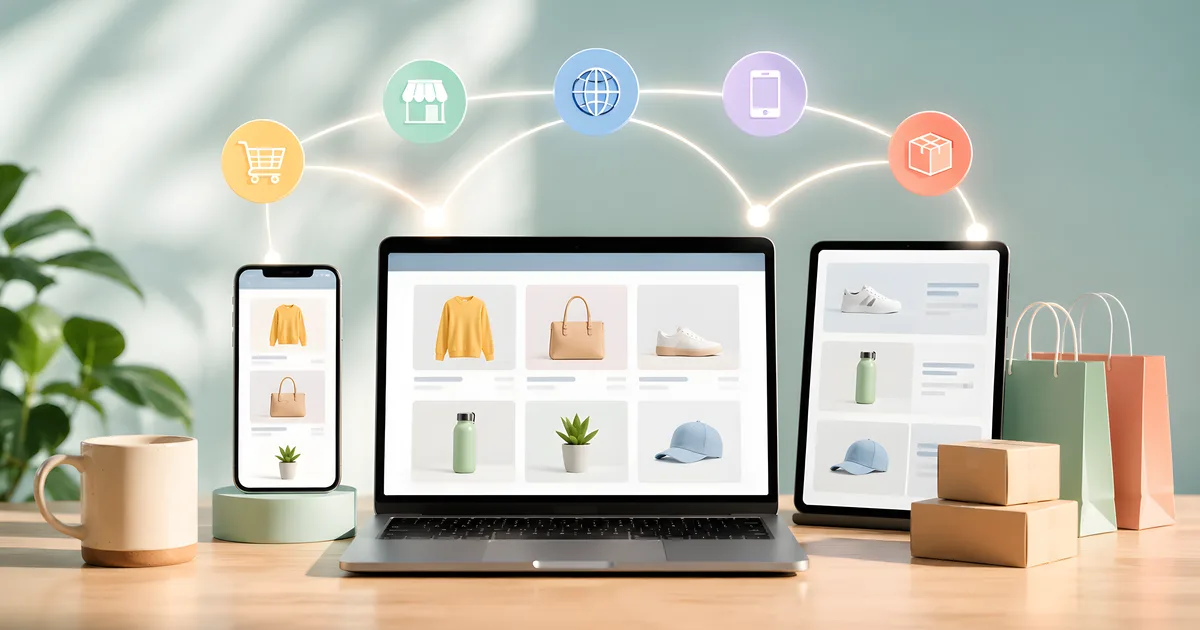
Start your online business today.
For free.
Start for freeMulti-channel sellers earn 190% more revenue than single-channel sellers, according to Shopify (2024). Selling across Amazon, your own store, social platforms, and marketplaces simultaneously multiplies your reach — but requires centralized inventory, consistent branding, and smart automation to avoid chaos.
- Consumers shop across an average of 7.6 channels before buying, and three-plus-platform brands earn 190% more revenue.
- Without centralized tools, 62% of merchants abandoned at least one channel within six months due to operational complexity.
- Centralized inventory management reduces stockouts by 62% and overstock situations by 41%, per Cin7.
- Rushing into three or more channels at once carries a 55% failure rate, versus 18% for adding channels sequentially.
- Consistent branding across channels increases revenue by up to 33%, and PIM tools cut listing time-to-market 60%.
Why Does Multi-Channel Selling Matter More Than Ever?
Consumers shop across an average of 7.6 channels before making a purchase, according to Harvard Business Review (2024). Brands that sell on three or more platforms generate 190% more revenue than single-channel sellers, per Shopify (2024). The era of relying on a single storefront is over — your customers are on Amazon, Instagram, TikTok, Google Shopping, Walmart Marketplace, and Etsy simultaneously, and they expect to find you wherever they browse.
Multi-channel selling is not simply listing products in more places. It requires synchronized inventory management, consistent pricing strategies, unified customer data, and platform-specific content optimization. According to BigCommerce (2024), 62% of merchants who attempted multi-channel selling without centralized tools abandoned at least one channel within six months due to operational complexity.
The Revenue Multiplier Effect
Each additional sales channel does not just add revenue incrementally — it creates a multiplier effect. According to Omnisend (2024), marketing campaigns that span three or more channels achieve a 494% higher order rate than single-channel campaigns. Customers who interact with your brand across multiple touchpoints develop stronger purchase intent and higher lifetime value. ChannelAdvisor (2024) reports that multi-channel customers spend 15–30% more per transaction than single-channel buyers.
Where Customers Actually Shop
Understanding channel distribution is critical for prioritizing your expansion. According to eMarketer (2024), Amazon captures 37.6% of US ecommerce sales, followed by Walmart at 6.4%, Apple at 3.6%, and eBay at 3.0%. However, social commerce is the fastest-growing segment: TikTok Shop grew 200% year-over-year in 2024, and Instagram Shopping drives $37 billion in annual sales globally (Meta, 2024).
US Ecommerce Market Share by Platform (2024)
Source: eMarketer, 2024
How Do You Choose Which Channels to Sell On?
Not every channel suits every product. According to Feedonomics (2024), the top factors for channel selection are audience demographics (cited by 78% of successful multi-channel sellers), fee structure (71%), category fit (68%), and integration complexity (54%). Spreading too thin across many channels is worse than dominating two or three. Start where your target customers already shop and expand methodically.
Channel-by-Channel Breakdown
- Amazon: Best for commoditized products with competitive pricing. Referral fees range 8–15%. Access to 310 million active customers (Amazon, 2024). FBA simplifies fulfillment but adds $3–$5 per unit.
- LaunchMyStore / Shopify / DTC Store: Best for branded products with higher margins. Full control over customer data and experience. Monthly cost: $39–$399 plus transaction fees of 0.5–2%.
- Walmart Marketplace: Growing fast with 120 million monthly unique visitors. Lower competition than Amazon. Referral fees: 6–15%. Requires application approval.
- TikTok Shop: Ideal for products with visual appeal targeting ages 18–34. Commission: 5% plus $0.30 per order. Viral potential is unmatched (TikTok, 2024).
- Instagram & Facebook Shops: Best for lifestyle, fashion, and beauty brands. Native checkout reduces friction. Meta charges 5% per shipment or $0.40 for orders under $8 (Meta, 2024).
- Etsy: Perfect for handmade, vintage, or unique products. 96 million active buyers. Transaction fee: 6.5% plus $0.20 listing fee (Etsy, 2024).
- Google Shopping: Drives high-intent traffic. Free listings available through Merchant Center. Paid ads average $0.60–$1.20 CPC for ecommerce (WordStream, 2024).
Matching Products to Platforms
Run a platform fit analysis before launching. List your top 10 SKUs, research each platform for competing listings, check average selling prices, and calculate net margin after platform fees. According to Sellbrite (2024), merchants who perform this analysis before expanding see 40% higher first-quarter revenue on new channels compared to those who list blindly.
Pro Tip: Launch on your second channel only after your primary channel is profitable and operationally stable. According to ChannelAdvisor (2024), merchants who rush into three or more channels simultaneously have a 55% failure rate within the first year versus 18% for those who add channels sequentially.
How Do You Manage Inventory Across Multiple Channels?
Inventory synchronization is the single biggest operational challenge of multi-channel selling. According to Stitch Labs (2024), 34% of ecommerce businesses have shipped an order late or canceled an order due to inventory miscounts across channels. Overselling damages your seller ratings on marketplaces and erodes customer trust. The solution is a centralized inventory management system that syncs stock levels in real time across all platforms.
Centralized Inventory Tools
Invest in a multi-channel inventory management platform that acts as a single source of truth. Top-rated options include Linnworks, ChannelAdvisor, Sellbrite, and Cin7. These tools sync inventory across your LaunchMyStore or Shopify store, Amazon, Walmart, eBay, and social channels with near-real-time updates. According to Cin7 (2024), merchants using centralized inventory management reduce stockouts by 62% and overstock situations by 41%.
- Set safety stock thresholds: Reserve 10–15% of inventory per channel to buffer against sync delays.
- Allocate inventory strategically: Assign more stock to higher-margin or faster-moving channels.
- Automate reorder points: Set triggers at minimum stock levels to auto-generate purchase orders.
- Use warehouse management: If using multiple warehouses, route orders to the nearest facility to reduce shipping costs and delivery times.
Handling Returns Across Channels
Returns must be processed back into available inventory quickly to prevent lost sales. According to the National Retail Federation (2024), ecommerce return rates average 17.6%. Each returned item that sits unprocessed for a week represents lost selling opportunity across all channels. Automate return processing so that once an item is inspected and cleared, it is immediately available for sale on every platform.
Multi-Channel Seller Revenue Growth by Number of Channels
Source: Shopify & ChannelAdvisor, 2024
How Do You Keep Branding Consistent Across Platforms?
According to Lucidpress (2024), consistent brand presentation across channels increases revenue by up to 33%. Yet every marketplace has different listing formats, image requirements, and content guidelines. The challenge is maintaining your brand identity while adapting to each platform’s constraints. Inconsistent branding confuses customers and dilutes trust — a buyer who finds your product on Amazon and then visits your Shopify store should immediately recognize the same brand.
Creating a Multi-Channel Brand Guide
Develop a channel-specific brand guide that adapts your core identity to each platform. Include image templates pre-sized for each marketplace (Amazon requires white backgrounds; Instagram favors lifestyle shots), approved copy variations for different character limits, and consistent pricing rules. According to Salsify (2024), brands with centralized product information management (PIM) systems update listings 4x faster and maintain 95% consistency across channels.
Product Content Optimization by Platform
- Amazon: Keyword-optimized titles (up to 200 characters), bullet points focused on features and benefits, A+ Content for enhanced brand storytelling.
- LaunchMyStore / Shopify: Story-driven product descriptions, lifestyle imagery, customer reviews prominently displayed.
- TikTok Shop: Short-form video showcasing the product in action, trending sounds, UGC-style content.
- Instagram: Curated grid aesthetics, shoppable posts with lifestyle context, Stories for limited-time offers.
- Google Shopping: Structured data markup, high-quality images on white backgrounds, competitive pricing visible in the feed.
Pro Tip: Use a Product Information Management (PIM) tool like Salsify, Akeneo, or Plytix to centralize all product data. Edit once, push everywhere. According to Akeneo (2024), PIM users reduce time-to-market for new product listings by 60%.
How Do You Automate Multi-Channel Operations?
Manual management of multiple channels is unsustainable beyond 50 orders per day. According to Linnworks (2024), merchants who automate order routing, inventory sync, and shipping label generation save an average of 20 hours per week and reduce fulfillment errors by 72%. Automation is not a luxury — it is a survival requirement for scaling multi-channel operations.
Adding countries multiplies the same complexity as adding channels, with duties and local payment methods on top. If international is your next expansion, cross-border ecommerce covers the tax, shipping, and localisation decisions to settle before you switch a market on.
Essential Automation Workflows
- Order routing: Automatically route orders to the nearest warehouse or fulfillment center based on customer location and stock availability.
- Inventory sync: Real-time stock updates across all channels every 5–15 minutes to prevent overselling.
- Price management: Automated repricing rules that adjust prices based on competitor data, channel fees, and margin targets.
- Shipping label generation: Auto-select the cheapest or fastest carrier based on order weight, destination, and delivery promise.
- Review aggregation: Pull reviews from all channels into a centralized dashboard for monitoring and response.
Tools for Multi-Channel Automation
The market for multi-channel management tools has matured significantly. Linnworks handles order management and inventory for 2,000+ integrations. ChannelAdvisor optimizes listings and advertising across 100+ channels. ShipStation automates shipping across carriers. For pricing, RepricerExpress adjusts Amazon prices in real time. According to Forrester (2024), merchants using integrated multi-channel tools see 35% higher operational efficiency within the first quarter.
What Are Common Multi-Channel Selling Mistakes to Avoid?
According to BigCommerce (2024), 47% of merchants who fail at multi-channel selling cite the same root cause: launching on too many channels simultaneously without adequate infrastructure. The second most common mistake (39%) is treating every channel identically rather than optimizing for each platform’s unique audience and algorithm. Understanding these pitfalls saves months of lost revenue and operational headaches.
The Top Five Mistakes
- Spreading too thin: Launching on five channels before mastering one leads to mediocre performance everywhere. Start with two, optimize, then expand.
- Ignoring platform-specific SEO: Amazon A9, Google Shopping, and Etsy search all use different ranking factors. Generic listings underperform by 40–60% (Feedonomics, 2024).
- Inconsistent pricing: Price discrepancies across channels frustrate customers and can violate marketplace policies. Use automated repricing tools.
- Manual inventory tracking: Spreadsheet-based inventory inevitably leads to overselling and stockouts as order volume increases.
- Neglecting channel-specific analytics: Each platform provides different metrics. Track channel-level profitability, not just aggregate revenue.
Building a Scalable Foundation
Before expanding to a new channel, ensure you have centralized inventory management, automated order routing, standardized product data, and channel-specific marketing budgets. According to Sellbrite (2024), merchants with all four elements in place before expansion see 3.2x higher first-year revenue on new channels compared to those who launch without infrastructure.
Frequently Asked Questions
How many channels should I sell on?
Start with two channels — typically your own store plus one marketplace like Amazon or Etsy. According to Shopify (2024), merchants selling on three channels see 120% more revenue than single-channel sellers. Add channels sequentially once each is profitable and operationally stable.
What is the best multi-channel inventory management tool?
Top options include Linnworks, Cin7, Sellbrite, and ChannelAdvisor. For small businesses (under 500 orders/month), Sellbrite offers affordable plans starting at $29/month. For larger operations, Linnworks and Cin7 provide enterprise features, according to G2 (2024).
Do I need different product photos for each platform?
Yes. Amazon requires white-background images as the main photo, while Instagram favors lifestyle imagery. According to Salsify (2024), platform-optimized images increase click-through rates by 25–40%. Create a master photo set and adapt it for each channel’s specifications.
How do I handle pricing across different marketplaces?
Use automated repricing tools like RepricerExpress or Informed.co. Account for each platform’s fee structure when setting prices. According to Feedonomics (2024), 67% of successful multi-channel sellers use dynamic pricing that adjusts automatically based on competition and channel costs.
Can I use Amazon FBA for orders from other channels?
Yes — Amazon’s Multi-Channel Fulfillment (MCF) program lets you fulfill orders from any sales channel using your FBA inventory. Fees are slightly higher than standard FBA, but it simplifies logistics significantly, according to Amazon Seller Central (2024).
Written by
Tyler Kim
Growth Strategist at LaunchMyStore. Helping online businesses scale with data-driven strategies and the latest ecommerce best practices.
 Keep Reading